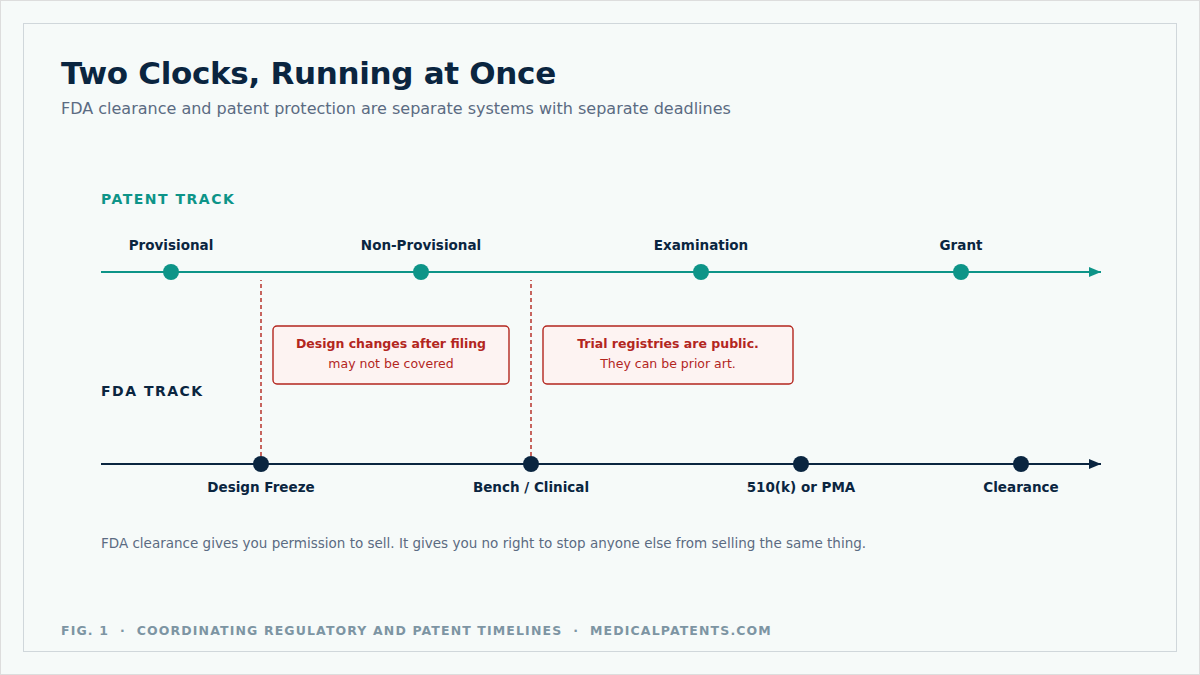
Medical devices occupy a regulatory and intellectual property intersection that most other technologies do not face. The same product that requires patent protection also requires FDA clearance or approval before it can be marketed. These two processes run on different timelines, involve different disclosure requirements, and create different legal consequences. Failing to coordinate them can result in lost patent rights, inadequate patent term, or unprotected products entering the market.
The Prior Art Problem
FDA submissions can create prior art against your own patent applications. A 510(k) summary becomes publicly available on the FDA's database after clearance. A PMA application may contain detailed technical disclosures. Published clinical trial data and conference presentations about the device also constitute prior art. If a patent application has not been filed before these disclosures become public, the disclosed subject matter may be used against the inventor's own patent claims. The one-year grace period under U.S. patent law provides some buffer for domestic filings, but no grace period exists in most foreign jurisdictions. The practical rule is straightforward: file the patent application before any public disclosure, including any FDA submission that will become publicly available.
Patent Term and Regulatory Delay
A utility patent's term is 20 years from the filing date of the non-provisional application. That clock starts running regardless of whether the device has received FDA clearance. For medical devices with lengthy regulatory review periods, a significant portion of the patent term may expire before the product reaches the market. Patent term extension under 35 U.S.C. 156 is available for certain products subject to regulatory review. The extension can restore up to five years of patent term lost to FDA review, subject to a cap of 14 years of effective patent life after FDA approval. Not all medical devices qualify; eligibility depends on the regulatory pathway and the specific patent claims. We evaluate patent term extension eligibility as part of the filing strategy.
Timing the Filings
The optimal filing sequence for most medical devices follows a pattern. A provisional patent application should be filed before any public disclosure or FDA submission. The non-provisional application should be filed within 12 months, timed to precede or coincide with the 510(k) or PMA submission. Continuation applications can be filed as the device evolves through the regulatory process. Design patent applications, which protect ornamental appearance, can be filed when the production design is finalized. This sequencing ensures that the earliest possible priority date is established, that disclosures made during the FDA process do not undermine patentability, and that the portfolio grows alongside the product.
510(k) Devices
For Class II devices cleared through the 510(k) pathway, the regulatory timeline is generally shorter. A 510(k) submission involves demonstrating substantial equivalence to a predicate device. The 510(k) summary, which becomes public, should not disclose patentable features that have not yet been covered by a patent application. When a 510(k) references a predicate device, the patent strategy should consider whether the claimed differentiation from the predicate is also the patentable differentiation from the prior art.
PMA Devices
For Class III devices requiring premarket approval, the regulatory timeline is longer and the disclosure requirements are more extensive. PMA applications include detailed device descriptions, clinical data, and manufacturing information. The extended review timeline makes patent term management more critical. Filing strategy for PMA devices should account for the likely duration of FDA review and plan continuation filings to ensure patent coverage remains active throughout the commercial life of the product.
Software as a Medical Device
Software-driven medical devices present additional complexity. FDA's regulation of software as a medical device (SaMD) is evolving, and the classification of SaMD determines the regulatory pathway. Patent protection for SaMD must navigate Section 101 subject matter eligibility requirements, which impose constraints on patenting software-implemented inventions. Coordinating the regulatory and patent strategies for SaMD requires attention to how the software's clinical function is described in both the FDA submission and the patent application.
Get Started
If you are developing a medical device and need to coordinate patent and FDA strategy, schedule a free consultation.