Patenting a medical device is not a single filing. It is a multi-step process that runs in parallel with product development, regulatory submissions, and often fundraising. Getting the sequence right matters. A poorly timed filing can forfeit rights; a poorly drafted application can leave critical features unprotected. This guide walks through each stage.
Step 1: Determine Whether Your Device Is Patentable
A medical device is patentable if it is novel, non-obvious, and useful. The threshold question is whether the device, or any specific aspect of it, differs from everything that came before it in a way that would not have been obvious to a person of ordinary skill in the field. "The device" does not have to be an entirely new category of instrument. A novel mechanism within an existing device category, a new combination of known components, or a software-driven diagnostic method can each be independently patentable.
Common patentable elements in medical devices include mechanical structures and linkages, materials and coatings, electronic control systems, sensor configurations, software algorithms that process clinical data, and methods of manufacturing or assembling the device.
Step 2: Conduct a Prior Art Search
Before investing in a patent application, a prior art search identifies what already exists in the public domain. For medical devices, prior art extends beyond issued patents. It includes published patent applications, peer-reviewed journal articles, FDA 510(k) summaries, conference presentations, and publicly available product literature. A thorough search at this stage informs the drafting strategy by identifying what claim scope is realistically available.
Step 3: Consider a Provisional Patent Application
A provisional patent application establishes a priority date at the USPTO without initiating examination. It costs significantly less than a non-provisional application and provides 12 months to refine the device, pursue FDA clearance, or secure funding, all while holding priority. The provisional must adequately describe the invention as of the filing date. An insufficiently detailed provisional is worse than useless because it creates a false sense of security. We draft provisionals with the same technical rigor applied to non-provisional applications.
Read our detailed guide on provisional applications for medical devices.
Step 4: File a Non-Provisional Patent Application
The non-provisional application is the formal filing that enters examination at the USPTO. It includes a specification (detailed written description of the device), claims (the legal boundaries of the patent), and drawings (detailed illustrations of the device and its components). For medical devices, the specification should describe the device in sufficient detail that a person skilled in the field could build and use it without undue experimentation. Claims should be layered: broad independent claims covering the core innovation, with narrower dependent claims capturing specific embodiments, materials, configurations, and methods of use.
Step 5: Navigate USPTO Examination
After filing, a patent examiner reviews the application and typically issues one or more office actions raising rejections based on prior art or formal requirements. Responding to office actions is where prosecution experience matters most. Medical device patents often face Section 101 issues for software-related claims, Section 103 obviousness rejections combining multiple prior art references, and restriction requirements splitting the application into multiple inventions. Effective responses distinguish the claimed device from cited prior art without unnecessarily narrowing the claims. Every amendment is permanent, so strategic discipline during prosecution preserves the value of the issued patent.
Step 6: Coordinate Patent and FDA Timelines
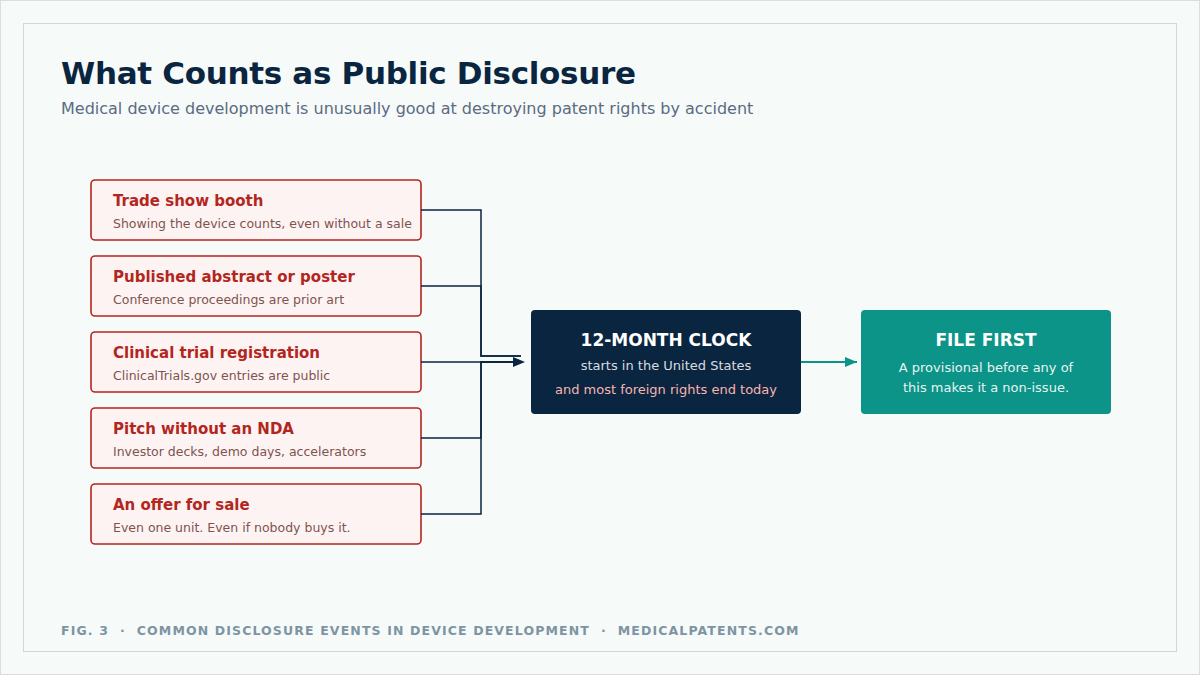
Medical devices occupy a unique space because the same product may simultaneously require both patent protection and FDA clearance or approval. Patent and regulatory timelines interact in important ways. Public disclosures in FDA submissions can create prior art if patent filings are not already in place. Conversely, the patent term begins running from the non-provisional filing date regardless of how long FDA review takes. For Class II and Class III devices with extended regulatory timelines, patent term adjustment or extension may be available to compensate for regulatory delay.
Learn more about coordinating FDA and patent strategy.
Step 7: Build a Patent Portfolio
A single patent rarely provides complete protection for a medical device product line. As the device evolves through clinical feedback, manufacturing optimization, and next-generation development, continuation and continuation-in-part applications can capture improvements and new embodiments. Design patents protect ornamental appearance. A deliberate portfolio strategy, built around the product roadmap, creates overlapping layers of protection that are far more valuable than any single patent.
Read about medical device patent portfolio strategy.
What It Costs
Patent costs for medical devices vary depending on the complexity of the technology, the number of independent claims, and the prosecution history. We provide transparent flat-fee quotes before beginning work wherever a project can be scoped. For a detailed breakdown, see our medical patent cost guide.
Next Steps
If you have a medical device at any stage of development, from napkin sketch to FDA-cleared product, and want to understand your patent options, schedule a free consultation. We will assess patentability, outline a filing strategy, and provide a fee estimate.