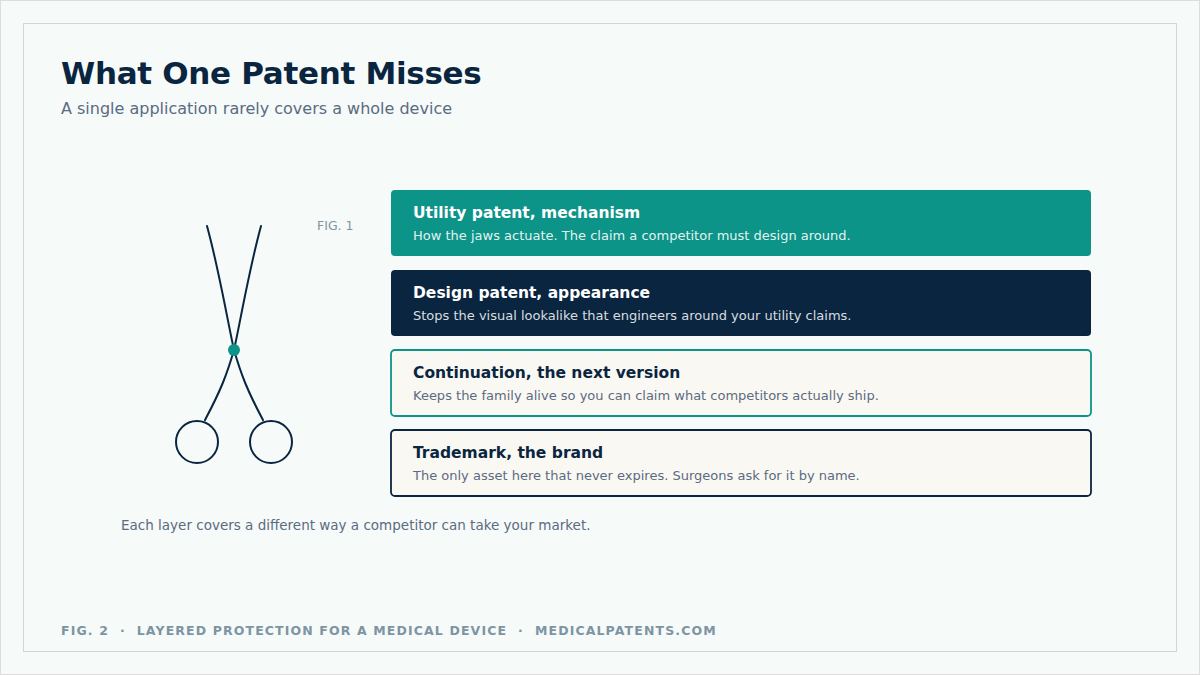
A single patent is rarely sufficient to protect a medical device business. Devices evolve through clinical feedback, manufacturing improvements, and next-generation development. Competitors design around narrow claims. Acquirers and investors evaluate the depth and breadth of IP coverage, not just the existence of a patent. A deliberate portfolio strategy transforms individual filings into a defensible asset.
Portfolio Architecture
An effective medical device patent portfolio is built around the product line, not individual inventions. The portfolio should cover the core mechanism or method (the foundational utility patent), alternative embodiments and design variations that a competitor might adopt, manufacturing methods and processes, software and firmware components, ancillary systems (data transmission, storage, analysis), consumable or disposable components, and the ornamental appearance of the device (design patents). Each filing addresses a potential vector of competition. The goal is to make it difficult, not merely inconvenient, for a competitor to bring a similar product to market without a license.
Continuation Strategy
Continuation applications are a critical portfolio tool. A continuation application claims the benefit of an earlier-filed parent application's priority date while presenting new claims directed to different aspects of the invention. For medical devices, continuations allow the company to pursue additional claim sets covering features that became commercially important after the original filing, claim configurations that competitors have adopted or are likely to adopt, broader or narrower claim scope based on the prosecution history of the parent application, and method claims complementing the apparatus claims in the parent. Continuation practice keeps prosecution options open without requiring new prior art searches or new filing dates.
Timing Filings to the Product Roadmap
Patent filings should be synchronized with product development milestones. The initial filing, typically a provisional, should precede any public disclosure. Subsequent filings should capture improvements and refinements as the device moves through prototyping, clinical testing, regulatory submission, and commercialization. For companies with a multi-product roadmap, the portfolio strategy should anticipate which product lines will generate the most revenue or face the most competition, and weight filings accordingly.
Portfolio for Fundraising and Acquisition
Investors and acquirers assess patent portfolios differently than operating companies. Investors want to see that the company's core technology is protected broadly enough to deter competition and that the portfolio has room to grow with the product line. Acquirers evaluate whether the portfolio covers the products generating revenue, whether the claims are defensible, and whether there are continuation opportunities for future filings. A portfolio built with these considerations in mind is materially more valuable at the transaction table than a collection of individually filed patents with no coherent strategy.
Cost Management
Portfolio building requires disciplined budgeting. Not every innovation warrants a patent filing. We help companies prioritize filings based on competitive significance, revenue potential, and enforceability. Trade secrets, defensive publications, and strategic timing can complement patent filings to provide coverage without exhausting the IP budget. The objective is maximum protection per dollar spent, not maximum filings.
Get Started
To discuss portfolio strategy for your medical device business, schedule a free consultation.