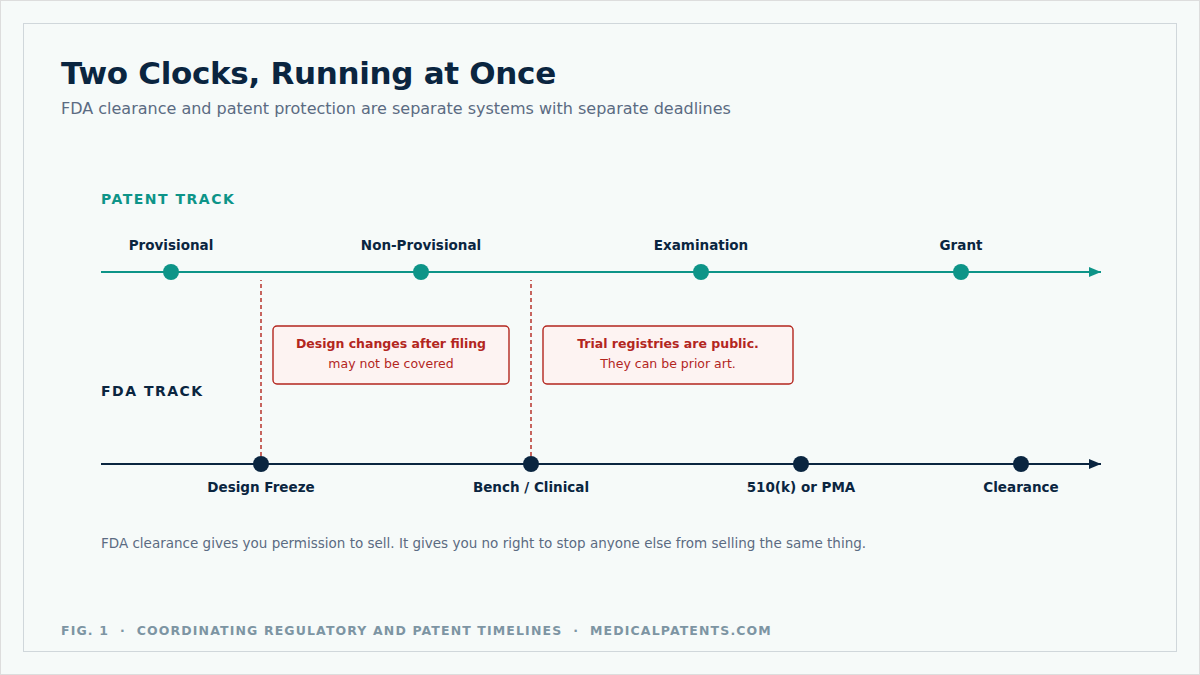
A 510(k) clearance is a real achievement. It is also one of the more reliable ways a device company accidentally publishes its own invention before filing on it.
Clearance is permission to sell. A patent is the right to stop others from selling. Different agencies, different statutes, different criteria, and they share nothing. A cleared device with no patent can be copied the day a competitor's own clearance issues, and your clearance does nothing to block theirs. That point is covered in Does FDA Clearance Protect My Device? This article is about the narrower and more practical question: when, relative to a 510(k), should the patent filings happen?
What the 510(k) Process Makes Public
While a 510(k) is under review, FDA generally treats the submission as confidential. The exposure starts at clearance and keeps going.
- The 510(k) summary. If you submit a summary, it is posted in FDA's public 510(k) database after clearance, alongside the clearance letter. The summary describes the device, its intended use, its technological characteristics compared to the predicate, and the performance testing. Written well, it is a compact technical disclosure of your device. If you submit a 510(k) statement instead, you commit to providing the safety and effectiveness information to anyone who asks, so the statement does not keep the device description private either.
- The predicate relationship. Your submission tells the world which marketed device yours is substantially equivalent to. That is a roadmap for a competitor deciding what to build and what to cite against you.
- Registration and listing. Once you are marketing, the device appears in FDA's public establishment registration and device listing records.
- Clinical data. If performance testing included a clinical study, the ClinicalTrials.gov registration is public by design, often long before clearance.
- Everything you do after clearance. The press release, the website update, the first booth, the first sale. The earliest one governs.
Each of these is a public disclosure under 35 U.S.C. 102. The 510(k) summary in particular is a printed publication: indexed, dated, and permanent.
The One-Year Grace Period, and Its Limits
The United States gives an inventor a grace period. Under 35 U.S.C. 102(b)(1), your own public disclosure made within one year before your effective filing date does not count as prior art against you. If FDA posts your 510(k) summary and you file within twelve months of that posting, the summary is excepted.
Three limits matter.
First, the clock runs from your earliest disclosure, not from the one you remember. If the device was shown at a meeting eight months before clearance, the year started then.
Second, the grace period is a U.S. rule. Most of the world has no equivalent. For a device with a market outside the United States, a published summary is the end of patent rights in those countries if nothing has been filed.
Third, the grace period protects you against your own disclosure. It does not stop a competitor who reads your summary, improves on it, and files on the improvement. In a first-inventor-to-file system, the grace period is a safety net, not a plan.
Relying on the grace period is a risk management decision, not a strategy. Filing before the summary publishes eliminates the question.
The Sequence That Works
For a device headed into a 510(k), the filing order that holds up looks like this:
- A provisional application early, on the design that exists, before any pre-submission meeting, clinical study registration, or conference. Pre-submission interactions with FDA are generally confidential, but they tend to coincide with the design settling, and that is the right moment to put a date on it.
- Another provisional if the design changes materially during verification and validation. There is no limit, and each one holds a date for what it describes.
- The non-provisional application within twelve months of the first provisional, timed to precede the 510(k) submission where the calendar allows. If the submission has to go first, the non-provisional still needs to be filed before the summary posts.
- A design patent application once the production design is frozen and before launch, if the device has a distinctive form.
- A continuation kept pending through launch, so that once competitors respond to your cleared device you can pursue claims aimed at what they actually built.
The full interaction between the two tracks, including PMA devices and software, is laid out in FDA and patent strategy.
Sameness for FDA, Difference for the USPTO
Inventors sometimes worry that the two filings contradict each other. The 510(k) argues that the device is substantially equivalent to a predicate. The patent application argues that the device is new and non-obvious over everything before it. Both can be true, because the questions differ.
Substantial equivalence asks whether the device has the same intended use and either the same technological characteristics as the predicate or different ones that raise no new questions of safety or effectiveness. Patentability asks whether the specific structure you claim was known or obvious. A new jaw mechanism in a grasper can be substantially equivalent to the predicate for regulatory purposes and patentable for its mechanism at the same time.
What matters is that the two documents are written by people who know what the other says. The differences you describe in the 510(k) to show the device is safe are often the same differences the patent application should be claiming. Those should line up.
Patent Term and the 510(k) Device
A utility patent runs twenty years from the non-provisional filing date, and that clock does not pause for FDA review. Patent term extension under 35 U.S.C. 156 can restore time lost to regulatory review, but it is generally tied to the premarket approval pathway, and a device cleared under 510(k) should not plan on it. The practical consequence is that the 510(k) timeline, which is usually the shorter one, should be run with the patent filings slightly ahead of it rather than waiting for either process to finish.
The Short Version
File a provisional before anything about the device becomes public, which in the 510(k) world means before the pre-submission, before any clinical registration, and well before the summary posts. Convert within twelve months. Keep a continuation open through launch. Treat the one-year grace period as a backstop for mistakes, not as part of the schedule.
Frequently Asked Questions
Does a 510(k) summary count as prior art against my own patent application?
Once FDA posts it, yes. It is a public, dated, printed publication. Under 35 U.S.C. 102(b)(1) your own disclosure within one year before your filing date is excepted in the United States, but most other countries have no such grace period, and the summary can be cited against you there.
Should I file the patent application before or after the 510(k) submission?
Before, if at all possible, and in any case before the 510(k) summary is posted after clearance. The cleanest sequence is a provisional application early in development, a non-provisional application within twelve months, and a continuation kept pending through launch.
Is the 510(k) submission itself public while FDA reviews it?
FDA generally treats a pending 510(k) as confidential. The public record begins at clearance, when the clearance letter and the 510(k) summary are posted, and it grows with registration and listing, marketing, and any clinical trial registration.
Can a device be substantially equivalent to a predicate and still be patentable?
Yes. Substantial equivalence is a regulatory question about intended use and safety and effectiveness. Patentability is about whether the specific claimed structure was known or obvious. A device can satisfy both at once, and the two documents should be written with each other in mind.
If a 510(k) is on your calendar, request a free consultation before the submission goes in. We will map the regulatory milestones against the filing deadlines and tell you where the gaps are.
This article is general educational information, not legal advice, and reading it does not create an attorney-client relationship. Patent law is fact specific and deadlines are unforgiving. For advice on your situation, schedule a consultation.