Medical device development runs long. Two years from concept to a design you are confident in is normal, and five is not unusual once regulatory work is in the picture.
That timeline creates a reasonable-sounding instinct: wait until the design is final, then file one strong application covering the finished product.
It is the wrong instinct, and it costs device inventors more rights than any other single decision.
Why Waiting Loses
The United States awards patents to the first inventor to file. Not the first to invent. If a competitor working on the same clinical problem files before you, your two years of development does not help you. Independent invention is not a defense.
Device development generates public disclosures constantly, usually without anyone recognizing them as such. The specific events are covered below, but the pattern is consistent: the same activities that move a device toward market are the activities that destroy patent rights.
Investors and strategic partners ask. "Patent pending" changes conversations with hospitals, distributors, and acquirers. A device with no filed IP is a harder story at every stage.
What Counts as a Disclosure
This is where device inventors get caught, because the disclosure is usually a professional obligation rather than a marketing choice.
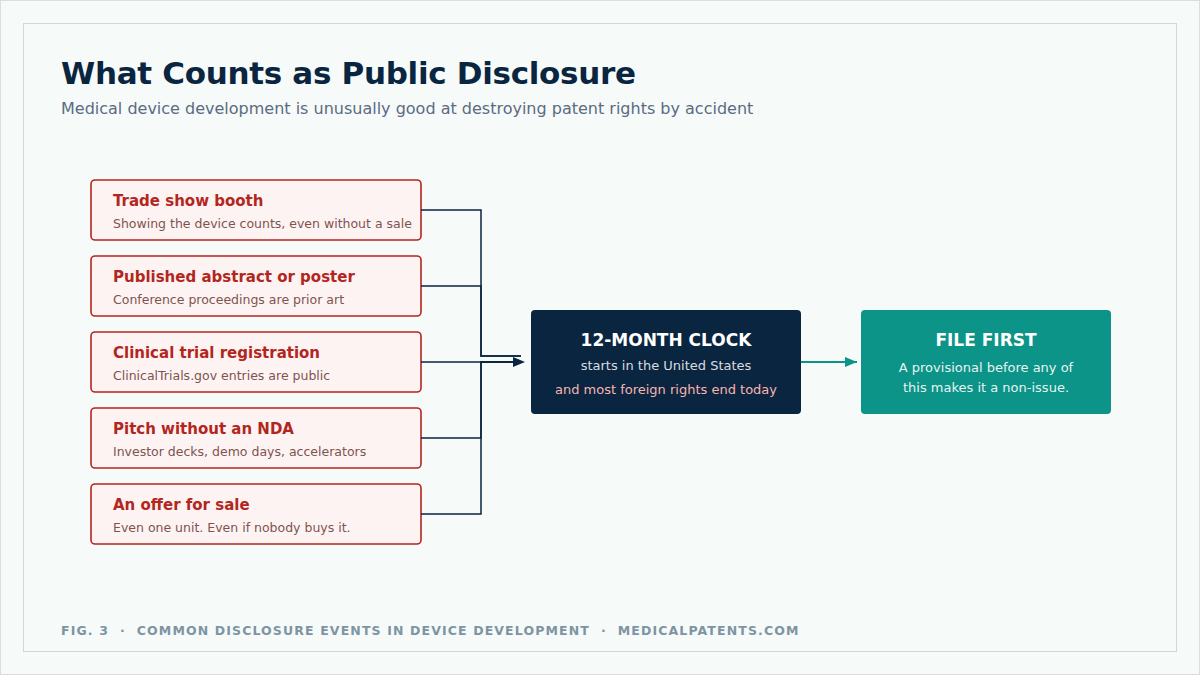
- Trade show exhibits. MD&M, AAOS, HIMSS, RSNA. Showing the device counts, even in a closed booth, even without a sale.
- Published abstracts, posters, and conference proceedings. A poster at a surgical society meeting is prior art the day the proceedings publish.
- Clinical trial registrations. ClinicalTrials.gov entries are public by design, and they describe the device.
- Investor pitches without an NDA. Demo days and accelerator presentations are public disclosures.
- Publications by your clinical collaborators. A surgeon co-developer publishing a case series can disclose your device without ever telling you.
- An offer for sale. Under 35 U.S.C. § 102(a)(1) this triggers the bar even if nobody buys, and the Supreme Court confirmed in Helsinn v. Teva that even a confidential offer can qualify.
- 510(k) summaries once FDA publishes them.
In the United States you get a twelve-month grace period for your own disclosures under § 102(b). In Europe, China, and most other markets, there is no grace period. Those rights end the day you disclose.
The most common version of this: an inventor does everything right for three years, presents at one society meeting before filing, and loses every foreign market in an afternoon.
The Answer: File Early, File Again
The practical strategy is not one perfect application at the end. It is a sequence.
File a provisional on the current design, before any disclosure. It does not have to be final. It has to be described well enough that someone skilled in the field could build it. A provisional is not examined, does not publish, and costs a fraction of a full application.
File updated provisionals as the design evolves. There is no limit. Each one holds a priority date for what it describes. If the actuation mechanism changes materially in month seven, file again. This is inexpensive relative to what it protects.
Convert within twelve months, claiming priority to the earliest provisional that supports each aspect. The non-provisional consolidates the family.
Keep the family open with continuations. By the time your device reaches market, you will know what competitors are building. A continuation lets you pursue claims aimed at what they actually shipped, which is worth more than claims aimed at what you guessed three years earlier.
The Limit You Need to Understand
A provisional only preserves priority for what it adequately describes under § 112(a). It must enable the invention.
This is where thin provisionals fail. Filing three pages and a photograph before a trade show feels like protection and often is not. If the provisional does not enable what you eventually claim, the priority claim fails for that subject matter, and you find out two years later when an examiner cites a reference published in the gap.
Design changes after filing are the recurring device-specific version of this problem. If you file on a design with a rigid shaft and later switch to an articulating one, the original provisional probably does not cover articulation. That needs its own filing.
The filing fee is the cheap part. The description is the entire value.
What About the Prototype?
You do not need one. U.S. law recognizes constructive reduction to practice, meaning a sufficiently detailed application satisfies the requirement without a working unit.
What you need is enough technical specificity that the description is genuinely enabling: materials, dimensional relationships, actuation mechanisms, tolerances that matter, and the alternatives you have considered. Include the variations you have not built. A specification that describes only the one version you made is a specification that a competitor can design around by making a trivial change.
Where Regulatory Timing Fits
The FDA pathway and the patent process are separate systems with separate deadlines, and they interact in two ways that matter:
Design freeze. Regulatory work pushes toward locking the design. Patent strategy wants filings that anticipate variation. File before the freeze on what exists, then file again on what the freeze produces.
Public regulatory records. Trial registrations and published 510(k) summaries are prior art. Sequence filings ahead of them.
There is also an upside. Patent Term Extension under 35 U.S.C. § 156 can restore up to five years of term consumed by regulatory review, which makes early priority dates more valuable in this field than in most. See FDA and patent strategy for the full interaction.
The Short Version
File a provisional on what you have now, before you show it to anyone outside an NDA. File again when the design changes materially. Convert within twelve months. Keep the family open.
Waiting for a finished design protects nothing. It only gives someone else time to file first, and gives your own disclosures time to become prior art against you.
To work out a filing sequence for your device, request a free consultation. What you describe is confidential from the first conversation, whether or not you hire us.
This article is general educational information, not legal advice, and reading it does not create an attorney-client relationship. Patent law is fact specific and deadlines are unforgiving. For advice on your situation, schedule a consultation.