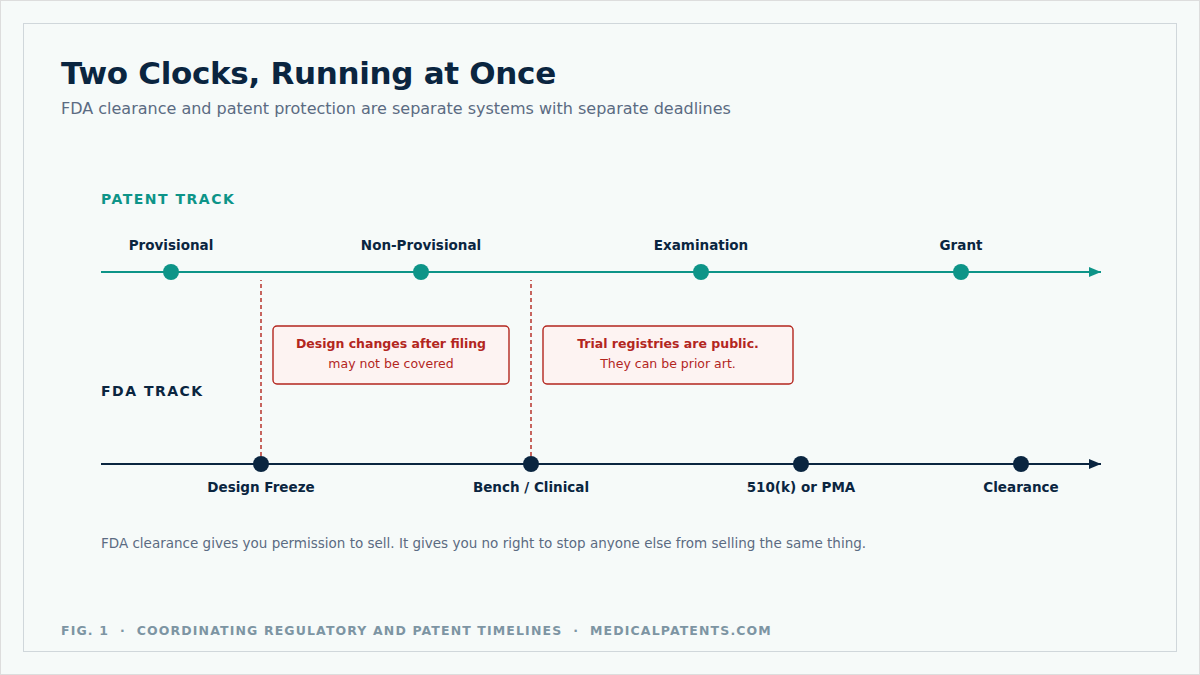
This misconception appears often enough, and costs enough when it goes uncorrected, that it deserves a direct answer.
FDA clearance or approval gives you permission to market your device. It confers no intellectual property rights of any kind. It does not stop a competitor from building the same device, clearing it themselves, and selling it against you.
The two systems share nothing. Different agencies, different statutes, different criteria, different timelines.
What Each One Actually Gives You
FDA clearance or approval answers a public health question: is this device safe and effective enough to be marketed? A 510(k) clearance means FDA agreed your device is substantially equivalent to a legally marketed predicate. A PMA approval means FDA found reasonable assurance of safety and effectiveness. Either way, the output is permission.
A patent answers a property question: does this person have the right to exclude others from making, using, or selling this invention? The output is exclusion.
You can hold one without the other, and both situations occur constantly:
- A cleared device with no patents can be copied the day a competitor's own clearance issues. Your clearance does not block theirs.
- A patented device with no clearance cannot legally be sold in the United States, but the patent still excludes everyone else.
Clearance Can Actively Hurt Your Patent Position
This is the part inventors do not anticipate.
510(k) summaries publish. Once FDA posts your clearance, the summary and its supporting description become public. That publication is prior art. If you have not filed by then, you may have started a twelve-month U.S. clock and ended your foreign rights.
Clinical trial registrations are public by design. A ClinicalTrials.gov entry describing your device is a disclosure. Registration is often required well before you are ready to file.
The predicate device relationship is a roadmap. Your 510(k) tells the world exactly which existing device yours is substantially equivalent to. That is useful information for a competitor deciding what to build.
Design freeze pushes the wrong way. Regulatory work drives toward locking a design. Patent strategy wants filings that anticipate variation. If you file only on the frozen design, you have claimed one embodiment and left the alternatives open.
The sequencing rule is simple: file before FDA publishes anything about your device. In practice that means filing a provisional well before you submit.
Where the Two Systems Help Each Other
The interaction is not all negative.
Patent Term Extension. Under 35 U.S.C. § 156, time consumed by FDA regulatory review can be restored to patent term, up to five years, capped at fourteen years of effective term after approval, for one patent per product. For PMA devices with long review cycles this is substantial, and it makes the choice of which patent to extend a real strategic decision.
Clinical data supports non-obviousness. Evidence of unexpected results, which you are generating anyway for FDA, is exactly the kind of secondary-consideration evidence that overcomes an obviousness rejection. Data developed for one purpose serves both.
Design history file discipline. The documentation practices required for design controls under 21 CFR 820.30 produce contemporaneous records of conception and development. Those records are useful for inventorship determinations and for establishing prior use.
What Clearance Does Give You Commercially
To be fair to the other side: clearance has real competitive value, it is just not legal exclusivity.
It is a barrier to entry, since a competitor must complete their own submission with their own testing and their own timeline. It carries first-mover advantage in hospital purchasing, where formulary and value-analysis committee positions are sticky. In limited cases there are genuine regulatory exclusivities, such as Humanitarian Device Exemption protections or pediatric provisions, though these are narrow and pathway-specific.
None of that stops a well-funded competitor. It slows them down.
The Combined Strategy
File patents before regulatory submissions publish. A provisional early, updated as the design develops, converted within twelve months.
Coordinate the timelines deliberately. Map your regulatory milestones against your filing deadlines and identify where a public regulatory record will land relative to your priority dates.
Keep a continuation pending through launch. Once competitors respond to your cleared device, you can pursue claims aimed at what they actually built.
Layer the protection. Utility patent on the mechanism, design patent on the appearance, trademark on the name. Clearance is not one of these layers, and it does not substitute for any of them.
Plan for term extension if you are on a PMA pathway with a long review.
The Short Version
FDA clearance means you may sell. A patent means others may not. If you have only the first, you have permission to compete in a market anyone can enter, including with a copy of your own device.
For the detailed interaction between the two timelines, see FDA and patent strategy. To coordinate a filing plan around your regulatory schedule, request a free consultation.
This article is general educational information, not legal advice, and reading it does not create an attorney-client relationship. Patent law is fact specific and deadlines are unforgiving. For advice on your situation, schedule a consultation.