Inventors who have never seen a patent application tend to picture a form. It is not a form. It is a technical document written to a legal standard, and the parts of it do different jobs. Knowing what each part does, and what only you can supply for it, makes the process faster and the result stronger.
This is what a U.S. utility application for a medical device contains, in roughly the order the Patent Office expects it.
The Specification
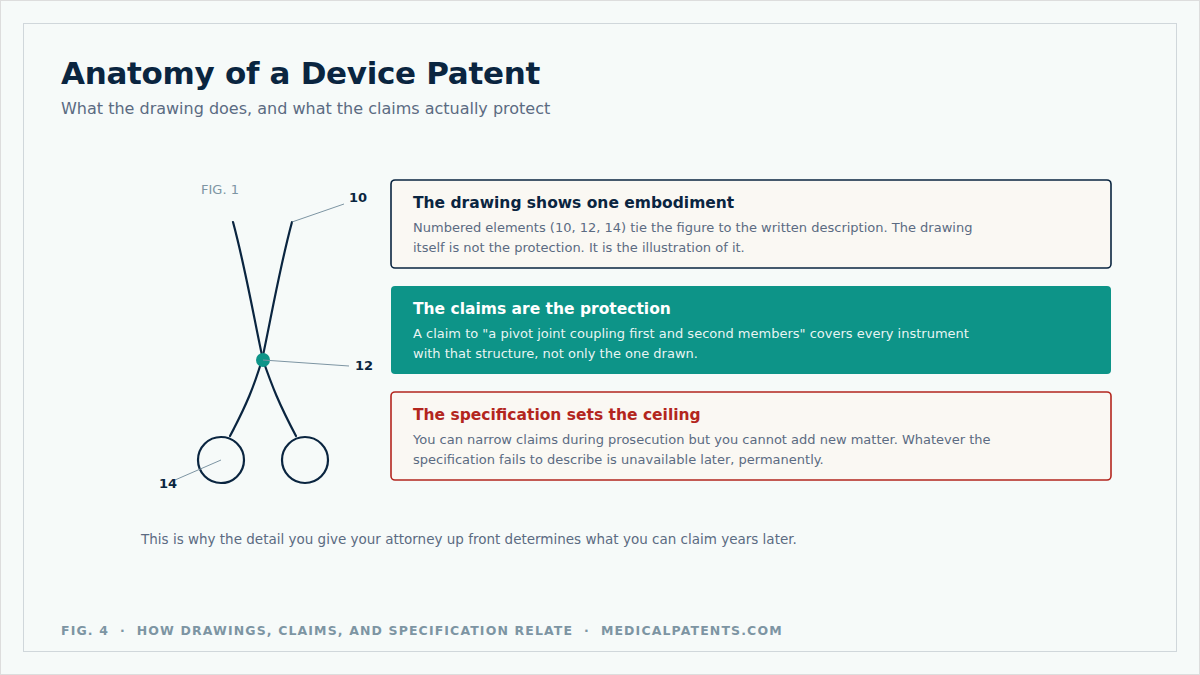
The specification is the written description of the invention, and it is the ceiling on everything that follows. Claims can be narrowed during examination. New matter can never be added. Whatever the specification fails to describe on the filing date is permanently unavailable.
It has conventional sections. A title. A field stating what the invention relates to. A short background describing the problem, written carefully, because how you characterize the prior art can be used against you. A summary. A brief description of the drawings, one line per figure. And the detailed description, which is the heart of the document.
The detailed description has to satisfy 35 U.S.C. 112(a): it must show that you possessed the invention, enable a person of ordinary skill to make and use it without undue experimentation, and set out the best mode you contemplated. For a medical device that means describing each component and its material, the relationships between components that make the mechanism work, how the device is actuated and used in the procedure, and, critically, the alternatives: other materials, dimensional ranges rather than one dimension, other actuation mechanisms, other procedures, scaled and single-use versions.
The question that drives this section is not "how does my device work." It is "how would a competent competitor build something that does this without infringing." Every answer belongs in the specification.
The Drawings
Patent drawings are disclosure, not decoration. A feature shown in a figure and described in the text is supported. A feature shown nowhere cannot be claimed later. For a mechanical device the set usually includes an overall view, cross-sections through the mechanism, an exploded assembly view, detail views of the parts that are the invention, and separate figures for each alternative. For a device with electronics or software, it includes a block diagram and flowcharts.
The drawings follow their own rulebook under 37 CFR 1.84: line weight, shading, margins, view numbering, reference numeral size. Every numeral in the drawings must appear in the description, and every numbered element in the description must appear in a drawing. A CAD export or a product photograph usually fails these rules, but it is excellent raw material. For instruments especially, the figures are where the mechanism gets pinned down.
The Claims
The claims define what you own. Everything else in the application exists to support them.
A claim set is layered. Independent claims stand alone and define the broadest protection the prior art allows. Dependent claims add features to an independent claim, narrowing it, and give you fallback positions if the broad claim is rejected or later challenged. A device application typically includes several claim types: the device itself, a system that includes it, a method of using it, and sometimes a method of making it.
Claims are written to the mechanism, not the product. "A surgical device comprising a handle, a shaft, and jaws" reads on everything, so everything anticipates it. A claim to the cam surface that keeps the jaws parallel under load covers every instrument that uses it, whatever the handle looks like. Claims also have to be definite under 35 U.S.C. 112(b), which among other things means every "the" refers back to something already introduced. Missing antecedent basis is a routine rejection, and it is invisible to a non-practitioner.
The Abstract
A single paragraph, limited to 150 words, summarizing the technical disclosure. It is used for searching and classification. It is not a marketing summary, and it should not be written like one.
The Formal Papers
Beyond the technical document, a filing includes an application data sheet identifying the inventors, the applicant, and any priority claims; an inventor's declaration; an assignment, if the invention is owned by a company or institution, which is recorded with the USPTO; and an information disclosure statement listing the prior art you know about. That last item reflects a duty of candor under 37 CFR 1.56, and it is not a formality. Withholding known material prior art can render an issued patent unenforceable.
A provisional application dispenses with the claims requirement and the declaration, but not with the specification and drawings. A provisional protects only what it teaches, which is why this practice drafts provisionals to the same standard as the full application.
What the Inventor Must Supply
An attorney can write the specification, produce the drawings, and draft the claims. Only the inventor can supply the facts they are built from. Before the first drafting meeting, assemble:
- A plain description of the clinical or technical problem and why existing devices fail at it
- What the device is and how it works, component by component
- Sketches, CAD, or photographs, however rough
- The alternatives you considered, including the ones you rejected and why
- Materials and dimensions, as ranges where ranges matter
- The closest existing devices or publications you know of
- Any test data, bench or clinical
- Every date on which the device was shown, presented, published, offered for sale, or registered
- Who contributed what, since inventorship is a legal determination and not a courtesy
- Any employment, consulting, or research agreements that might affect ownership
Why the Disclosure Meeting Matters
Inventors describe the version they built. The specification has to describe every version a competitor might build. Closing that gap is the purpose of the disclosure meeting, and it is why an application drafted from a questionnaire, or by a tool that only knows what you typed into it, tends to be thin exactly where it needs to be broad.
In that meeting an engineer-attorney asks what else would work, what happens if a feature is reversed or removed, what dimensional window the mechanism tolerates, what adjacent procedures the device could serve, and which features are essential rather than incidental. Inventors routinely answer "that part is obvious" about the feature that turns out to be the invention. It felt obvious after they solved it. The meeting is where those features get noticed, described, and claimed.
The time to supply this material is before filing. After filing it is new matter, and the door is closed. Drafting and prosecuting the application is the core of the work this practice does, and it starts with that conversation.
Frequently Asked Questions
What are the main parts of a medical device patent application?
The specification, which is the written description; the drawings; the claims; and the abstract, together with formal papers such as the application data sheet, the inventor declaration, any assignment, and an information disclosure statement listing known prior art.
What does the inventor have to provide?
The facts the application is built from: the problem, how the device works component by component, sketches or CAD, the alternatives considered, materials and dimensional ranges, the closest existing devices, any test data, every public disclosure date, who contributed what, and any agreements that might affect ownership.
Can I add details to the application after it is filed?
No. New matter cannot be added after the filing date. Claims can be narrowed and corrected, but anything the specification and drawings did not disclose on the day of filing is unavailable. Material that comes later goes in a new application.
How long is the abstract, and does it matter?
The abstract is limited to 150 words and summarizes the technical disclosure for searching and classification. It is not where protection comes from. The claims are. Write it accurately and move on.
To start an application, request a free consultation. We will tell you what is ready to file, what still needs to be worked out, and quote a fixed fee that is confirmed in writing before any work begins. How fees are structured over the life of an application is described in the medical patent cost guide.
This article is general educational information, not legal advice, and reading it does not create an attorney-client relationship. Patent law is fact specific and deadlines are unforgiving. For advice on your situation, schedule a consultation.