Surgeons who design instruments almost always open with the same concern: "there must be a thousand patents on graspers already."
There are. It rarely matters as much as they expect, and the reason is worth understanding before you decide not to file.
Crowded Fields Are Narrow Fields
A dense prior art landscape means existing claims are narrow, not that the space is closed. Each of those thousand patents claims a specific structural combination. Your instrument does not need to be unprecedented. It needs to be different in a way that is not obvious, and the difference is often something you already consider unremarkable.
The things that regularly support allowable claims:
- A joint or linkage configuration that changes force transmission or articulation range
- Ergonomic geometry that alters how the surgeon's hand loads the instrument during a specific maneuver
- A material or coating combination that changes tissue interaction, thermal behavior, or cleanability
- Integration of previously separate functions into one instrument, cutting an exchange step
- Structural features that enable a specific technique the prior art could not perform
- Modularity or reprocessing features that change lifecycle economics
The recurring pattern in this practice: an inventor describes their instrument as "basically a standard laparoscopic grasper with a slightly different jaw pivot," and the pivot turns out to be the whole invention, because it lets the jaws close parallel under load rather than converging at the tip.
Surgeons routinely undervalue their own modifications because the modification feels obvious to them. It felt obvious after they solved it. The prior art is evidence it was not obvious before.
Claim the Mechanism, Not the Instrument
The most consequential drafting decision in instrument patents is the level of abstraction.
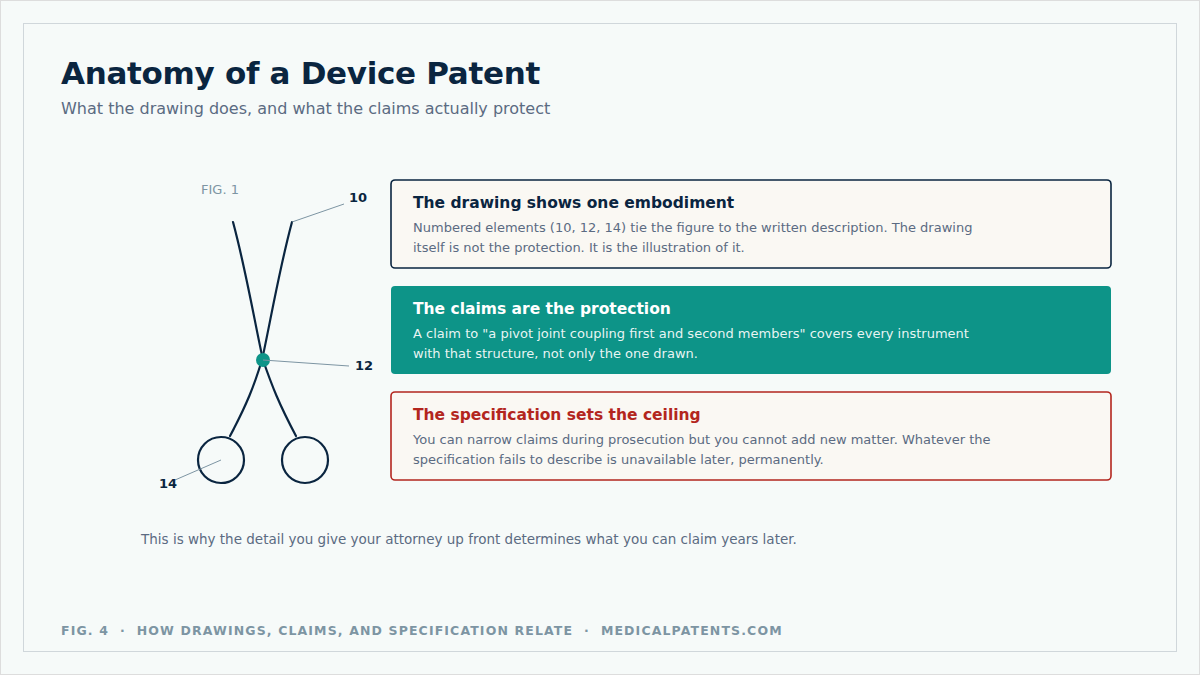
A claim to "a laparoscopic grasper having a handle, a shaft, and jaws" is worthless. It reads on everything, which means it is anticipated by everything.
A claim to the specific structural relationship that makes yours work is what has value. If the invention is a cam surface that maintains parallel jaw closure, claim the cam surface and its relationship to the jaw members. That claim covers every instrument using that mechanism, including instruments that look nothing like yours and are used in entirely different procedures.
This is where technical depth in drafting changes the outcome. An attorney who understands the mechanism will claim the mechanism. An attorney who does not will claim the instrument as described, and a competitor will change the handle and ship.
Design Patents Are Underused Here
Utility patents cover how it works. Design patents cover how it looks, and for surgical instruments they are more valuable than most inventors assume.
They are faster to obtain, often issuing in about a year against three or more for a utility patent. They are cheaper. They have no maintenance fees, and they run fifteen years from grant, so prosecution time does not erode the term.
And they address a specific failure mode. A competitor who successfully designs around your utility claims still has to sell an instrument that looks different from yours. Surgeons develop preferences for instruments they can identify by sight. A design patent protects that recognition in a way a utility patent does not.
The strongest instrument positions file both, plus a continuation to keep the family open, plus a trademark on the instrument name. That layering is the subject of design patents for medical devices and portfolio strategy.
The Specification Sets Your Ceiling
You can narrow claims during prosecution. You can never add new matter.
Whatever your specification fails to describe is permanently unavailable. This is the single most expensive mistake in device patents, and it is invisible until years later.
A thorough instrument specification should describe:
- Alternative materials for each component, including ones you have not tested
- Dimensional ranges rather than only the prototype's dimensions
- Alternative actuation mechanisms that achieve the same result
- The variations you rejected and why, which supports non-obviousness
- Adjacent procedures the instrument could serve
- Reprocessing, sterilization, and single-use configurations
- Scaled versions for pediatric, robotic, or open approaches
The question to ask during drafting is not "how does my instrument work." It is "how would a competent competitor build something that does this without infringing." Every answer belongs in the specification.
Who Is the Inventor?
Instrument development is collaborative, and inventorship is a legal determination rather than a courtesy.
An inventor is someone who contributed to the conception of at least one claimed element. A machinist who built exactly what you specified is not an inventor. An engineer who solved the actuation problem you could not is. A surgeon who identified the clinical need but contributed nothing to the structure is not, however essential they were to the project.
Getting this wrong has consequences. An improperly named inventor can render a patent unenforceable, and an omitted inventor retains rights they can later assert or assign to someone else.
Two related traps in this field:
Hospital and university employment agreements. If you are a practicing physician, your employer may have a claim on inventions related to your clinical work. Check before you file, not after.
Industry collaborations. Joint development agreements with a manufacturer frequently allocate IP in ways inventors do not notice until they try to license elsewhere.
The Practical Sequence
- Document the invention in technical terms, including the alternatives.
- Search the prior art before drafting. In a crowded field this is worth doing properly, because it tells you what claim scope is realistically available.
- File a provisional before any conference, trade show, or publication.
- File a design application in parallel if appearance is distinctive.
- Convert within twelve months, with claims aimed at the mechanism.
- Keep a continuation pending so you can claim what competitors ship.
To discuss an instrument, request a free consultation. The consultation is free, confidential, and handled by an attorney who is also a mechanical engineer and a device inventor.
This article is general educational information, not legal advice, and reading it does not create an attorney-client relationship. Patent law is fact specific and deadlines are unforgiving. For advice on your situation, schedule a consultation.