Device inventors usually arrive having heard of utility patents and treating design patents as a lesser option. For medical devices specifically, that framing costs people money.
What Each Protects
A utility patent covers how the device works: structure, mechanism, method of use, and function. It is the stronger right in the abstract, because it can stop a competitor whose product looks entirely different but operates the same way.
A design patent covers how the device looks: the ornamental appearance of its shape, surface, and configuration. It cannot stop a functionally identical device that looks different. It can absolutely stop one that looks the same.
The Practical Comparison
Term. Utility patents run twenty years from filing, and because they are enforceable only after grant, three years of prosecution leaves seventeen. Design patents run fifteen years from grant, so prosecution time costs you nothing. In practice the effective enforceable periods are closer than the headline numbers suggest.
Cost. A design application is a fraction of a utility application, both to prepare and to prosecute. The drawings are the application, and drawing quality is what determines scope.
Speed. Design patents commonly issue in roughly a year. Utility patents typically take two to four.
Maintenance. Utility patents require fees at 3.5, 7.5, and 11.5 years, escalating substantially. Design patents require none at all.
Examination. Design applications are allowed at a much higher rate. The claim is the drawing set, so there is far less to argue about.
Enforcement. Design patent infringement uses the ordinary observer test: would an ordinary observer, familiar with the prior art, think the two designs are substantially the same? This is often easier to prove than utility infringement, which requires mapping every claim element onto the accused product. Design patents also carry a remedy available nowhere else in patent law: under 35 U.S.C. § 289 you can recover the infringer's total profits on the article of manufacture, not merely your lost profits or a reasonable royalty.
Why Devices Are a Good Fit for Design Patents
Three reasons specific to this field.
Surgeons buy by recognition. Instruments become familiar. A surgeon who has used your device across two hundred cases reaches for the shape they know. A visual lookalike exploits that directly, and a design patent is the tool built for it.
Regulatory pathways favor visual similarity. A competitor pursuing 510(k) clearance benefits from demonstrating substantial equivalence to a predicate device. That creates structural pressure toward products that resemble yours.
Design-arounds are a real threat. Utility claims can be engineered around. A competitor who changes your actuation mechanism enough to escape your utility claim, but keeps the housing and profile that surgeons recognize, is stopped by a design patent and nothing else.
The best case for a design patent is precisely the case where your utility patent fails: a competitor who solved the mechanism differently but wants your product's familiarity.
Where Design Patents Do Not Help
They protect ornamental appearance only. Features dictated purely by function are not protectable through a design patent, and a design patent whose every feature is functionally required is vulnerable to invalidation.
For a device whose appearance is entirely determined by its function, such as an implantable component shaped solely by anatomy, a design patent may add little. Distinctive housings, handles, user-facing surfaces, and instrument profiles are where the value sits.
They also cannot stop a functionally identical device that looks meaningfully different. If your innovation is entirely internal, a design patent protects the wrapper rather than the invention.
The Layered Approach
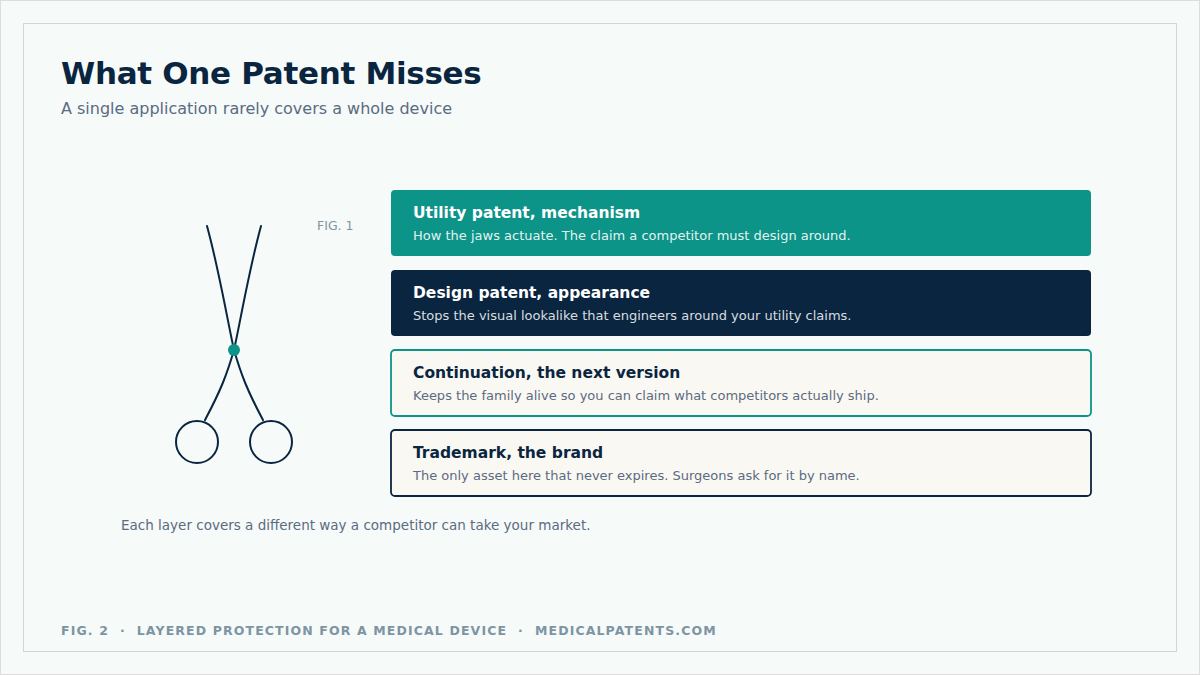
For most devices with any distinctive form, the strongest position files both:
Utility patent on the mechanism. This is the primary asset and the one that appears in diligence.
Design patent on the appearance. Fast, inexpensive, no maintenance, and it closes the design-around gap.
Continuation kept pending on the utility family, so you can pursue claims aimed at what competitors actually ship once you can see it.
Trademark on the device name. The only asset in this list that never expires, and for a device surgeons request by name, frequently the most durable of the four.
Each layer covers a distinct route a competitor can take. Filing only the utility patent leaves three routes open.
A Sequencing Note
Both applications should generally be filed before any public disclosure, for the same reason: public disclosure starts a twelve-month U.S. clock and ends foreign rights immediately in most jurisdictions.
Design applications have a further wrinkle. Because the drawings define the claim, filing on a design that later changes leaves you protecting a product you no longer sell. Where the industrial design is still moving, either wait until the housing is settled or plan on a second filing.
The Short Version
Utility patents protect how it works and take longer and cost more. Design patents protect how it looks, issue quickly, require no maintenance, and offer a total-profits remedy available nowhere else. For medical devices, where surgeons buy by recognition and competitors are structurally pushed toward visual similarity, filing both is usually the right call rather than a luxury.
See design patents for medical devices for more on the design side, or request a free consultation to discuss the right mix for your device.
This article is general educational information, not legal advice, and reading it does not create an attorney-client relationship. Patent law is fact specific and deadlines are unforgiving. For advice on your situation, schedule a consultation.